
Tuesday, February 1, 2011
Transport Time
The C-17 flight from CHC to MCM has taken off. We received notice about our transport times. 1300. The flight will land around 1430 in McMurdo. With a turn around time of about 1 hr we might be leaving for New Zealand around 1530. We can track the progress of the C-17 flight to Antarctica on the USAP site. Very cool!


Another Boomerang
It is departure day at the Pole. Everyone is anxious to leave. You settle in to station life quickly and adapt well to the daily routine at Pole. But once your departure day has come everyone is anxious to leave. We are watching the flight schedule, the departure times from MCM, as well as the estimated arrival times at Pole. The first flight to Pole is usually the PAX in/out (passenger in and out flight).
We go outside waiting for the plane to land. Far in the distance we can see the plane appear in the sky. It is the reflection of the Sun that you first notice. The plane is a Hercules C-130. The propellers leave a white trail behind. We notice that the plane is still unusually high. Is it our perception? After a few more minutes it becomes clear that the plane is maintaining altitude. It turns, makes a loop over the airstrip and heads back into the direction it came from.
Communciation tells us that the skis didn't deploy. Mechanical problems. Like yesterday. We go inside and wait for the next flight.
Luckily another flight will be coming in later in the afternoon.
We end up leaving Pole in the afternoon, arriving at Pegasus airfield near MCM in the evening. With temperatures just below freezing it feels warm at MCM.
We go outside waiting for the plane to land. Far in the distance we can see the plane appear in the sky. It is the reflection of the Sun that you first notice. The plane is a Hercules C-130. The propellers leave a white trail behind. We notice that the plane is still unusually high. Is it our perception? After a few more minutes it becomes clear that the plane is maintaining altitude. It turns, makes a loop over the airstrip and heads back into the direction it came from.
Communciation tells us that the skis didn't deploy. Mechanical problems. Like yesterday. We go inside and wait for the next flight.
Luckily another flight will be coming in later in the afternoon.
We end up leaving Pole in the afternoon, arriving at Pegasus airfield near MCM in the evening. With temperatures just below freezing it feels warm at MCM.
Transantarctic Traverse
Every year there are some groups traversing Antarctica. To deliver supplies and fuel to the stations around the continent, to test new vehicles and methods of transportation, or to push the limits of human endurance. This year a supply caravan went from McMurdo to the South Pole. The round trip takes about 5 weeks. Three weeks in (with fuel) and 2 weeks out. Snowcats and tractors are used to pull bladders of fuel. Bladders turn out to have much less resistance than fuel containers on skis or sleds. They plan to develop GPS-guided machines and robots that can make this traverse...


Unrestricted visibility
Today we have blue skies and unrestricted visibility. It is a clear day with -30 deg C (-44 with windchill). It is amazing how far one can see. The South Pole is a very flat and large place. STP, ICL, Viper, and the clean air lab now all appear so close to the station. I see for the first time how far the horizon extends behind these buildings. A seemingly endless desert of snow and ice.
It is tourist day. A plane with a handful of tourists just landed. They land on the same air strip next to the station but then taxi all the way to the Pole. I guess for about $40,000 per person you can expect to be "driven" all the way to the Pole.
Monday, January 31, 2011
Maps and Info on Antarctica
I just came across the website of the British Antarctic Survey. It is a great resource for maps and all sorts of info. Check it out: http://www.antarctica.ac.uk
For some useful fact sheets from the BAS see: http://neutrino.physics.wisc.edu/antarctica/
For some useful fact sheets from the BAS see: http://neutrino.physics.wisc.edu/antarctica/
Boomerang
The new South Pole station let's you easily forget that you are at the end of the World. With good food, a gym, a science lab, conference rooms as well as game and video rooms you find here more facilities and amenities than in many other experimental locations I have worked at. But sometime Nature tells you that it is still in control down here. Everything depends on the weather cooperating and equipment not failing in the harsh conditions.
Yesterday the satellite connection failed and we lost internet connection. There is nothing one can do about it. And there is no coffee shop around the corner to help you get your webfix. You are just disconnected from the world. Life is confined to the events on the Station. While there is an Iridium link for emergency phone calls, on days like yesterday life on the station is quite isolated.
Several flights were planned for yesterday. The first flight had to "boomerang" after it had flown 3hrs from McMurdo to the Pole. The landing skis didn't deploy. The plane circled for about 15 min above the Pole and then made a decision to return to MCM. On the Pegasus airfield at MCM the plan can use its wheels to land on the compressed and hardened runway.
Sunday, January 30, 2011
It's snowing at the South Pole
It is snowing at the Pole! - Usually the Pole is a very dry place. And most days the wind picks up ice crystals so that you have the impression of snow falling. Today we have whiteouts again and it just started snowing for real. A rare occasion for the Pole. The air warmed up. Moisture is coming from the Weddell Sea.
The weather here is dominated by either the cold clear air from the plateau (the East Grid, as they say) or the Wedell Sea. The plateau brings nice cold weather, the sea brings the clouds, whiteouts, and....snow.
We are scheduled to leave Pole tomorrow. We will have to watch the weather closely. The C-130 planes require at least 1km of visibility to land.
The weather here is dominated by either the cold clear air from the plateau (the East Grid, as they say) or the Wedell Sea. The plateau brings nice cold weather, the sea brings the clouds, whiteouts, and....snow.
We are scheduled to leave Pole tomorrow. We will have to watch the weather closely. The C-130 planes require at least 1km of visibility to land.
HEAT at the dryest, calmest, coldest place on Earth
Every Sunday there is a science lecture at the South Pole. Projects and experiments introduce their work to the South Pole community. Station staff and scientists together listen to the latest work at the Pole and in Antarctica. Yesterday, we heard about HEAT, a new THz astronomy experiment to be deployed at on Ridge A, near Dome A. The goal of the experiment is to observe the Milky way in THz light and learn about gas and cloud formations. This observation requires the dryest and thinnest atmosphere possible. Water in the atmosphere will absorb the THz radiation and make the measurement impossible. Even the mountains of Hawaii, the Chilean desert, and the South Pole (!) are still too humid for this experiment.
The location of choice is Ridge A, near Dome A. The highest location on the Antarctic plateau. There is no station. It is one of the coldest and most hostile places on the continent. The Chinese are planning to build a telescope near Dome A. The average temperatures at this place are about -60 deg C. At the Pole it is only -48 deg C. The experiment is deployed in day trips and then runs remotely for a year at a time. During the winter data is transferred via an Irridium Satellite link. The data transfer per day is a maximum 10MB!
This makes the 9hr-per-day broadband connection at the Pole seem awesome in comparison.
For more information on Ridge A see http://en.wikipedia.org/wiki/Ridge_A
and http://www.wired.com/wiredscience/2009/08/bestplaceonearth/

The location of choice is Ridge A, near Dome A. The highest location on the Antarctic plateau. There is no station. It is one of the coldest and most hostile places on the continent. The Chinese are planning to build a telescope near Dome A. The average temperatures at this place are about -60 deg C. At the Pole it is only -48 deg C. The experiment is deployed in day trips and then runs remotely for a year at a time. During the winter data is transferred via an Irridium Satellite link. The data transfer per day is a maximum 10MB!
This makes the 9hr-per-day broadband connection at the Pole seem awesome in comparison.
For more information on Ridge A see http://en.wikipedia.org/wiki/Ridge_A
and http://www.wired.com/wiredscience/2009/08/bestplaceonearth/
Saturday, January 29, 2011
Racing to reach Lake Vostok....
Some updates on the Russian effort to reach Lake Vostok
http://www.bbc.co.uk/news/science-environment-12275979
and some pictures
http://www.bbc.co.uk/news/world-12302953
http://www.bbc.co.uk/news/science-environment-12275979
and some pictures
http://www.bbc.co.uk/news/world-12302953
Exceptions to the Antarctic Treaty .. in the name of science
With the Antarctic Treaty all nations have agreed to eventually remove everything from the continent and not leave any trash etc behind. Last night I learned that the IceCube experiment required an exception. With 5000 photomultipliers frozen 2.5km deep into the ice there is no chance for a post-operation cleanup or removal. The IceCube detectors will stay frozen in the Antarctic ice forever. Or until the glacier pushes them off the continent in millions of years. At Pole the glacier speed is about 10m/year. The distance to McMurdo is about 1100km. The Transantarctic Mountain Range is in between.
End of season ... celebration!
The summer season is coming to an end at the Pole. Most scientists will be leaving next week. The station is getting ready for the winter. One of the major events this weekend is the South Pole International Film Festival (SPIFF) followed by a party in the summer camp. SPIFF features short films, photographs, and slide shows made by the people working at Pole. Station staff, scientists, techs, support people... everyone can show their creative side. It is a fascinating insight into the life and humor at the Pole. We summer scientists don't really belong to the group that runs the station.
SPIFF also featured slides of the old, original SP station that was finally buried in the ice this past year. The photographs of the old station revealed a much harder life. This was the time when men were still men. The new station is just so much neither. Like a luxury hotel in comparison.
The party in the summer camp is about half a km away from the station. A temporary tent camp that is only used during the summer. It is strange to walk in bright day/night light at 10pm to a party.
The next morning I get up early. My daily routine is set by the satellite time from 02300 to ~11am. I take a walk outside the SP station. I appear to be the only person around. Everyone else is sleeping. It is Sunday. No snowmobiles or machinery are running at this hour of the day. It is a strange experience. Everything is quiet except for the Antarctic wind. The wind is calming down. With windchill it is now only -38 deg C. I love this weather.
SPIFF also featured slides of the old, original SP station that was finally buried in the ice this past year. The photographs of the old station revealed a much harder life. This was the time when men were still men. The new station is just so much neither. Like a luxury hotel in comparison.
The party in the summer camp is about half a km away from the station. A temporary tent camp that is only used during the summer. It is strange to walk in bright day/night light at 10pm to a party.
The next morning I get up early. My daily routine is set by the satellite time from 02300 to ~11am. I take a walk outside the SP station. I appear to be the only person around. Everyone else is sleeping. It is Sunday. No snowmobiles or machinery are running at this hour of the day. It is a strange experience. Everything is quiet except for the Antarctic wind. The wind is calming down. With windchill it is now only -38 deg C. I love this weather.
Friday, January 28, 2011
- 55 deg C
Today we got a tour of the tunnels at South Pole Station. The tunnels are an underground network of utility tunnels doug 50ft below the surface of the ice. They run all underneath the station, connect the summer camp with the main station, and the garage facilities. Sewage, water, and fuel run in these tunnels. They are also used to access the water supply caves and the undeground sewage cave for servicing.
Walking around these tunnels is a strange experience of the "underworld". You hear the heavy machinery driving above on the ice, combined with the smell of a distant sewage facility. In some remote corners winter crews have carved little, bizzare shrines into the wall of these ice tunnels.
The temperature in these tunnels is -55 deg C. All year round. Dress warm!
Walking around these tunnels is a strange experience of the "underworld". You hear the heavy machinery driving above on the ice, combined with the smell of a distant sewage facility. In some remote corners winter crews have carved little, bizzare shrines into the wall of these ice tunnels.
The temperature in these tunnels is -55 deg C. All year round. Dress warm!
Thursday, January 27, 2011

A small world
What are the odds that 4 physics graduate students who all attended the University of Washington at the same time end up working at the South Pole? One is working on IceCube, one on the South Pole telescope, one was a winter over in 2004, and now me.
What are the odds that two Germans who grew up in the same town end up at the Pole? It turns out that IceCube winterover is from my home town.
There must be at least a dozen Germans at the Pole right now. I wonder what draws Germans to this location....?
What are the odds that two Germans who grew up in the same town end up at the Pole? It turns out that IceCube winterover is from my home town.
There must be at least a dozen Germans at the Pole right now. I wonder what draws Germans to this location....?
An Antarctic experience
Today is a typical day in Antarctica. Clear, cold weather with strong winds. Visibility is unlimited. You can see the horizon. There is a white haze hovering above the snow from the ice crystals picked up by the wind. You turn around 360 degrees and you see nothing but a flat, white horizon and a blue sky. Pictures really don't do it justice. It is a very calming and extraordinary sight. I would call it the Antarctic experience.


Population decline
Population decline at the South Pole. With every flight going in and out of the Pole people are now leaving the station. It is the end of the season. The population is now declining from 250+ during the peak of the summer season to about 50. The winter crew is getting ready. There are now up to 7 fligths a day to the Pole to deliver fuel for the winter. The temperatures are dropping and sunshine is now at 20hrs per day. Today's weather is clear and cold. Bright, sunny, and winds up to 20 knots. A brisk antarctic wind.
$130 for one minute of internet
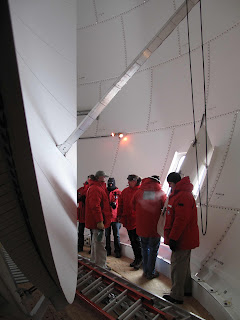
The other day we got a tour of the satellite communication facilities at the Pole. It gave us a whole new appreciation of the internet connectivity. South Pole station uses two satellites for their communication GOES and TDRS. There is about 9 hours of satellite coverage per day at the Pole. The technology is 30 years old. GOES is an old weather satellite and TDRS belongs to NASA. We get bandwidth when NASA doesn't use it for other higher priority missions such as shuttle lounges. The satellite connection is equivalent to a T1 line. A satellite engineer is at the station to keep it all running. Satellite coordinates have to be uploaded every few days, the old communication dishes have to be oiled and greased. The server motors for the GOES dish require to be kept at room temperature all year round. This is a place to warm up. The IceCube experiment can transfer about 60-80GB a day via satellite.


Wednesday, January 26, 2011
Sunshine
It makes all the difference how you feel at the Pole. Everyone's mood is so much better now.


Tuesday, January 25, 2011
Whiteout
Whenever you see pictures of the South Pole you are likely to see postcard-like photographs of a blue sky with bright snow conditions. People in their parkas usually form colorful contrasts to the white and bright environment in sunny weather conditions. This week the weather is quite different. For several days we have had whiteout conditions. Ice clouds are moving through, visibility is low. Sometimes even below 0.5 mile. Yesterday most flights between McMurdo and the Pole were cancelled. We are waiting for the weather to improve.


Monday, January 24, 2011
A day at the Pole
Getting up at 0300 to catch the early satellite time. Email and web work. Central Time is 19 hrs behind New Zealand time. Early morning coincides with the work day in the US. Breakfast time. There is a dessert for every meal. The food is fantastic at the SP station. The SP staff calls for help. Boxes of food need to be unloaded and need to be stacked in the freezer inside the station and outside on the balcony, the natural freezer. We make a human chain and carry boxes for an hour. At 0800 there is a daily work meeting with the IceCube group. I am here to help commission the new DM-Ice dark matter detector. It is sunny outside. I take a walk around the Pole. 24 time zones in 15 min. The weather can change quickly here. An hour later visibility is poor and ice crystal clouds are everywhere. In the morning everyone is usually busy because the internet is accessible. Then it is time to check on the icetop tanks and clean up the ICL. It is time to have lunch but ... the satellite is still up. Trying to catch the last few minutes of internet connectivity.


Subscribe to:
Posts (Atom)